
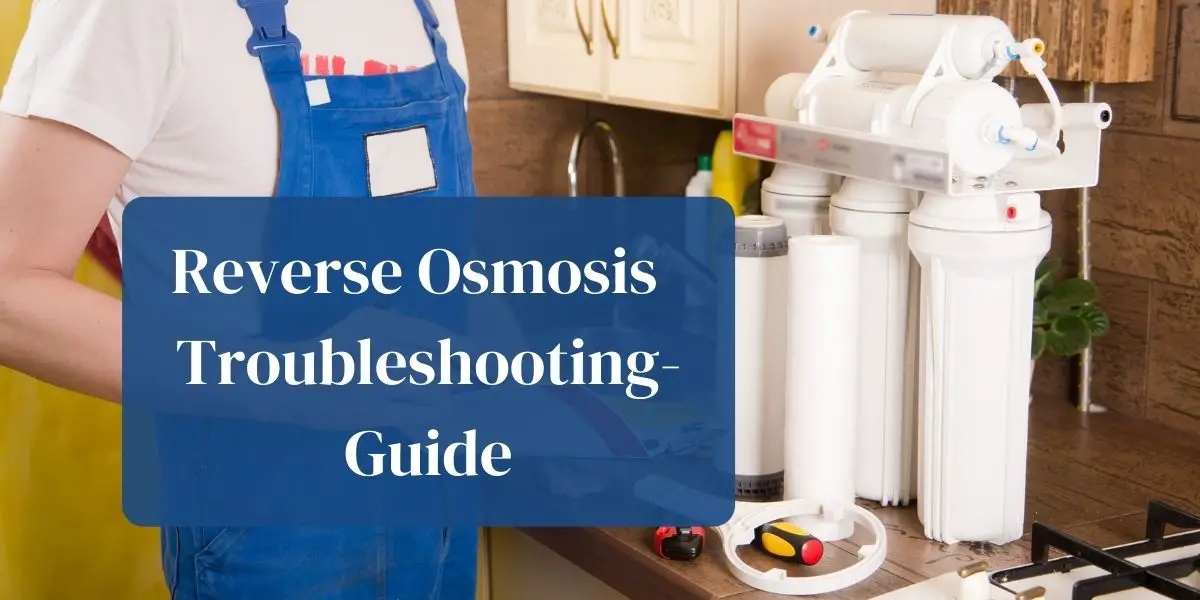
Most reverse-osmosis problems come from one of five areas: feed pressure, clogged prefilters, the membrane, the storage tank or the drain-flow controls. Start with the simplest checks and use the system’s manual for model-specific pressures, filter intervals and replacement parts.
If the system is leaking, shut off its feed-water valve before troubleshooting. If water quality suddenly changes, stop drinking the product water until the cause is identified and the system has been sanitized or serviced as required.
Quick reverse-osmosis diagnostic checklist
- Confirm the feed valve and tank valve are fully open.
- Look for kinked tubing and obvious leaks.
- Note the date when the sediment and carbon prefilters were last changed.
- Let an emptied system refill for several hours before judging output.
- Measure feed pressure and product-water total dissolved solids (TDS) if you have suitable gauges or meters.
- Compare every reading with the manufacturer’s manual.
Certification is not the same as troubleshooting, but it helps when choosing replacement equipment. NSF/ANSI 58 covers material safety, structural integrity, TDS reduction and any additional contaminant-reduction claims made for a residential RO system. Use the NSF certified-product listings to check an exact model rather than relying on a generic claim.
1. No water from the RO faucet
First confirm that the feed-water and tank valves are open. A newly installed or recently emptied tank may simply need time to fill. If the valves are open and the tank feels empty after several hours, check for a clogged prefilter, low feed pressure, frozen or kinked tubing, or an automatic shutoff valve that is not operating correctly.
A tank that feels heavy but delivers no water points toward lost air charge, a damaged bladder, a closed tank valve or a blocked postfilter. Tank pressure must be checked only after the water side has been emptied; the correct empty-tank pressure is model-specific. Follow our detailed RO tank-pressure procedure rather than adding air while the tank is full.
2. Slow flow or a tank that fills slowly
Cold water, low household pressure and a fouled membrane all reduce production. A blocked sediment or carbon prefilter can do the same and may also expose the membrane to chlorine if replacement is overdue. Replace filters on the schedule specified by the manufacturer, then allow the system to refill and retest.
Do not assume that a booster pump is the first answer. Measure feed pressure and compare it with the unit’s operating range. If pressure is adequate but output remains low, test rejection performance before replacing the membrane.
3. Water runs to the drain continuously
An RO system normally sends concentrate to the drain while producing water. It should usually stop after the storage tank is full. Continuous draining can result from low pressure, an undercharged or failed tank, a damaged automatic shutoff valve, a faulty check valve, incorrect tubing or a missing or blocked flow restrictor.
Close the tank valve and watch what happens according to the manufacturer’s test procedure. Do not drill, enlarge or remove the drain restrictor: it establishes the flow needed for membrane operation and changing it can damage performance.
4. Gurgling or other unusual noises
Some gurgling is normal after installation or a filter change because air is leaving the system. Drain noise can also occur while the membrane is producing water. Persistent vibration, hammering or very loud drain noise may indicate loose tubing, high pressure, a poorly positioned drain saddle or an obstructed drain connection.
Make sure tubing is secure and the drain saddle is installed where the manual specifies—not on the bottom of a horizontal waste pipe or after a garbage disposal unless expressly allowed. A plumbing professional should correct drain configurations that do not meet local code.
5. Bad taste or odor
A stale tank, exhausted carbon postfilter, overdue filters or bacterial growth can affect taste and odor. After installing filters, flush the volume required by the manual. If the unit has been idle, flooded or contaminated, replace affected cartridges and sanitize the housings, tubing and tank using the manufacturer’s procedure.
RO does not make unsafe source water automatically safe under every condition. The CDC’s home water-treatment overview recommends choosing a treatment method for the germs or chemicals actually present. For an unexplained or sudden odor, investigate the source water as well as the RO unit.
6. High TDS or poor contaminant reduction
Compare feed-water and product-water TDS with a calibrated meter after the system has been running and the tank has been refreshed. A high product reading can reflect membrane wear, damaged seals, incorrect membrane seating, low pressure or mixing from a remineralization stage.
TDS is a broad conductivity-based indicator, not a test for every contaminant. A low reading does not prove that water is microbiologically safe. If a specific contaminant is the concern, use an appropriate certified laboratory test and a system certified for that reduction claim.
7. Cloudy water or faucet sputtering
Fine bubbles commonly make water look milky after installation or service. Fill a clear glass and wait: if the cloudiness clears from the bottom upward within a minute or two, trapped air is likely. Flush the system as directed. Cloudiness that settles as particles, persists, or comes with odor should be investigated rather than dismissed.
8. Leaks around housings, fittings or the faucet
Shut off the feed water, open the RO faucet to relieve pressure and dry the area so the source is visible. Push-connect tubing must be cut squarely and inserted to the specified depth. A leaking filter housing may have a dirty, twisted or damaged O-ring, or it may be overtightened or cracked.
Never use petroleum jelly on an O-ring unless the manufacturer explicitly allows it; use the specified food-grade lubricant. Replace cracked housings and damaged fittings rather than trying to seal them externally.
9. RO water tastes flat or has an unexpected pH
RO removes many dissolved minerals, so its taste differs from mineral-rich tap water. Exposure to air can also shift pH because low-alkalinity water absorbs carbon dioxide. Our guide to the pH of reverse-osmosis water explains why a single pH number can be misleading. If taste preference is the only issue, a correctly sized remineralization stage may help, but it should not conceal poor membrane performance.
When to call a professional
Arrange qualified service for recurring leaks, contaminated well-water concerns, damaged electrical pump components, unexplained loss of rejection, plumbing-code questions or a system that still malfunctions after routine filter and pressure checks. Bring the model number, filter dates and measured feed/product TDS to make diagnosis faster.
The safest order is simple: stop leaks, verify valves and pressure, replace overdue consumables, test performance, then replace components only when the evidence points to them.


I was never aware that a noisy faucet is a sign that our osmosis needs to be repaired. The other day I noticed my dad’s reverse osmosis system was giving out a loud noise and had a leaky faucet. I will ask my dad to have it repaired or serviced.
I have a red residue build up at the very tip of the nozzle. Every month I have to swab with a Q-tip to clean. However, today I swabbed and also discovered metal chips!! I change my RO filters every 6 months. I have a whole house twin filter system in the cellar; 5 micron charcoal and that pours into a 1 micron filter. Thus the RO gets filtered water. Yet I get this residue one month after changing the RO unit. What is going on?
i just installed an r.o machine yesterday and tpday its not working it is only flushing throughout pleas help me
Just replaced all filters elements on a culligan reverse osmosis system, tank 7 psi, and after two hours of operate the lead line into the polishing filter popped out, making loud noise. What is causing the pressure to pop this line out of filter?
Undocumented – the black line is undocumented and has a flow restricter.
Well, I moved my RO unite in the basement and cut my own black line to reach
Here is the bad part. I ordered the spare 4 filters (including the RO) with the new unit.
The APEC ROES-50 manual page 20 shows a different filter – very different!
It also indicates a wrong way to install.
But, the tech at APEC says the filter after a time, can go bad.
So, I ordered another $36.00 filter to try and replace it.
I just don’t understand in this day of Internet, why this much documentation can be missing or wrong! It isn’t the $50 of parts and shipping so much as the many hours of trying to troubleshooting and waiting my turn on the support line. Maybe 18 hours.
APEC 5 stage – ordered filter replacement kit with new unit. A year later replaced filters. The 3 filter below had film, cleaned and disinfected, dried out, no problem.
The RO membrane was a whole other story. The faucet runs like there is no RO at all. TDS indicates no RO taking place for sure.
The Documentation is lacking. Just one image of the RO, but nothing to really help.
Called, sent photos, video to APEC support.
It was working before I replaced the filters. I have replaced many filters before.
I don’t know how to test the 4 way switch on this unit. Not sure if support does either.
Hate to throw away something because of poor documentation.
My RO water pressure was very slow so I repressuurized the tank and water stopped flowing all together. I thought it was the automatic shutoff valve so I depressurized the whole system and tried it again and still no water. Any ideas before I have to call someone?
I have a 4 stage RO for 9 months. Water started coming foamy on the surface. 4 Filters were changed but the foamy water still is on the surface. What is the problem and how to solve it?
I have a GE RO system, I recently had an issue with the tank pressure and had to repressurize. After doing so, the tank was filling and the system was working properly, but after about a week, I could only get about a cup of water out of the system and then no flow at all. I then rechecked the pressure in the tank and also cleaned the flow control. Same result, tank filled, system seemed to working good, then little to no water and it doesn’t seem to fill, can only get a cup of water out. Any ideas on what the issue might be? I have tried to not use the sytem to see if it will completely fill, but it doesn’t seem to matter how long I wait.
I have a 6-stage R.O. system (2 polishers).
I’ve had the system for about 8 years and routinely change out filters and membrane.
On my recent change-out I replaced the tank with a new one of the same(P.A.E. ro-132).
Water flows to the tank (flows freely when not connected to tank ball valve and that valve is perfect), but the new tank will not accept any water.
Pressure on the new tank arrived with 5.0 psi.
Building psi is 50.
I’m stumped.
Is there an effective way to remove the reverse osmosis microbubbles? like, if I put a filter after the reverse osmosis filters? would it remove the bubbles?
Where can I get O rings for my RO system housing sumps. It’s a CE 5 stage system. I tried the APEC rings as they are the right OD and ID, but they are only 1/8″ thick. My system needs a slightly thicker O ring, about 3/16″. Appreciate any help, thanks,…Gary. 4353596332
changed out all filters and membrane a couple weeks ago. I am getting terrible water 178 to 215 PPM in water was 54 ppm before filter and membrane change. I double and triple checked connections and sequence of hookup. Does anyone have an answer for this.
HELP
always purge your filters before installing the membrane.its possible that the membrane is fouled by the loose carbon from the filters .
I have a 4stage reverse osmosis found that my tank does not fill.changed tank with new one same problem.changed out membrane still same problem.so i brougt brand new 4stage still same probkem tank wont fill what can cause this help
sounds like you have too much air pressure in the storage tank . let out some air til the tank has 7-8psi . use a tire gauge to set the air pressure.
After draining the tank about five times the water still comes out cloudy on occasion
My tank is barely filling up (5 gallon tank and less than 1 gallon will go in it). This happened after changing all filters. I emptied the tank and set the PSI to 7 then hooked it back up. I still get barely any water.
Could this be a problem with new membrane?
Yes, there could be a problem with the new membrane.
i just installed a new kitchen faucet. During installation, I turned off the R.O. system. After installing my new faucet, I saw some black stuff come out of the faucet and shortly thereafter, my water pressure quickly decreased. Now I have minimal water pressure even though I turned the R.O. system back on? I checked to make sure the water lines leading to the new faucet weren’t pinched, but still have minimal pressure through the new faucet??
My system ran out of salt,and the system stopped. It has been sitting for several months and we haven’t done anything with it. Is there an automatic shut off or did we do permanent damage to the system by letting it run out of salt?
I have a GE RO system. we have been enduring a drip drip noise in the drain line. Suggestions?
where do I find “clean silicone grease”?
I would lengthen the drain line into trap (or set the tap closer to bottom of drain piping)
I just started my 2 year filter change (sediment, pre-carbon, and post -carbon) and discovered that the old sediment and pre-carbon cartridges are covered in a thick yellow-orange wax. This waxy stuff was thickest at the bottom of the cartridges and in the bottom of the filter housing. What is this, and should I be concerned? I carefully washed the filter housings and installed the new filters and re-installed onto the base unit.
I wouldn’t be worried about that waxy stuff if you have removed it. That just means your filters are working properly.
If it was me I’d get the water tested.