
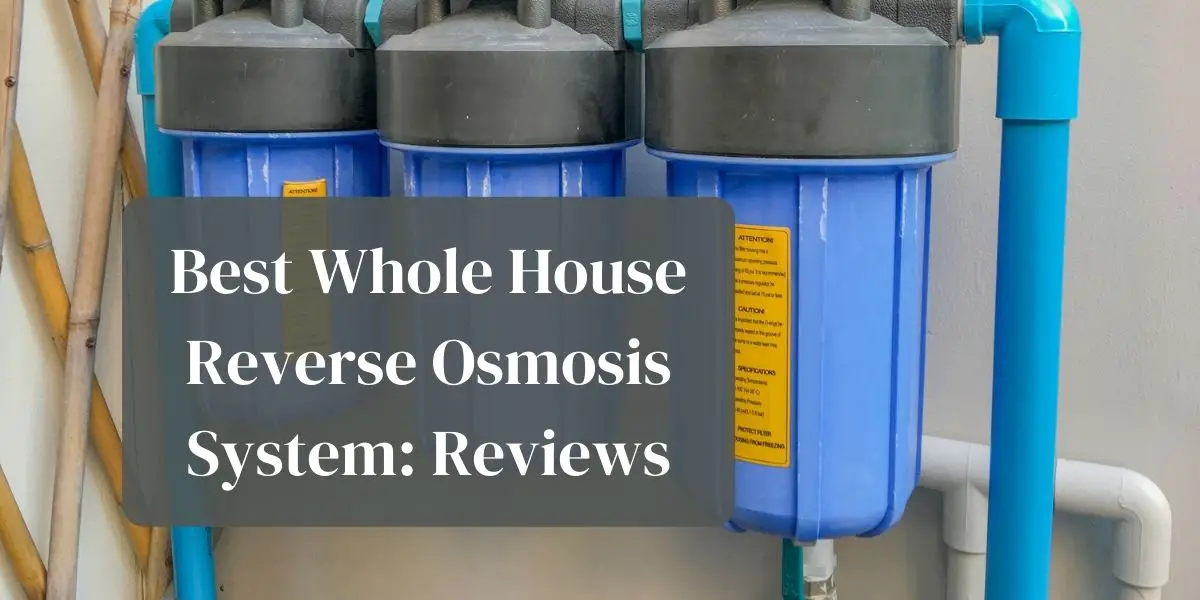
Whole-house reverse osmosis can be worth it when laboratory testing confirms a dissolved contaminant or high salinity problem across the entire supply and a water-treatment professional designs the system around the home’s flow rate. For most households on compliant mains water, it is more treatment than they need. A point-of-use RO unit at the kitchen sink is usually smaller, cheaper and less wasteful.
A whole-house system is not simply a larger under-sink filter. It normally needs pretreatment, a high-output membrane, storage, repressurisation and ongoing monitoring.
Whole-house RO versus point-of-use RO
| Question | Whole-house RO | Point-of-use RO |
|---|---|---|
| What it treats | Water for most or all fixtures | One drinking-water tap or appliance |
| Typical reason | A supply-wide dissolved-contaminant or salinity problem | Drinking and cooking water needs targeted treatment |
| Space | Equipment area plus a large storage tank | Under-sink or countertop footprint |
| Flow | Must meet peak household demand | Lower production rate is acceptable |
| Complexity | Pretreatment, pumps, controls and post-treatment | Compact multi-stage unit |
| Water use | Potentially substantial reject stream | Smaller total treated volume |
When whole-house RO may be justified
- Brackish or unusually high-total-dissolved-solids water affects the whole property.
- A tested contaminant must be reduced at multiple fixtures, not only at the kitchen sink.
- A specialist has confirmed that simpler treatment cannot meet the objective.
- The property can accommodate a storage tank, drain connection, electrical supply and service access.
- The owner accepts the maintenance cost and has a plan for the reject water.
Private-well owners should begin with testing rather than equipment quotes. The EPA recommends that private wells be tested annually for total coliform bacteria, nitrate, total dissolved solids and pH, with additional testing where local risks suggest it. See the EPA’s guidance on how to protect a home’s well water.
What a complete system usually includes
Pretreatment
Sediment, hardness, iron, manganese, chlorine and biological fouling can damage or clog an RO membrane. The correct pretreatment depends on the test results and membrane specification. A softener or iron filter may be required before the RO stage, while chlorinated supplies may need carbon treatment where the membrane is chlorine-sensitive.
RO membrane and controls
The membrane array must produce enough treated water under the site’s actual pressure, temperature and feed-water chemistry. Production ratings measured under favourable laboratory conditions should not be treated as guaranteed household output.
Storage and repressurisation
Because demand can exceed the membrane’s immediate production rate, whole-house designs commonly fill an atmospheric tank and use a delivery pump to supply fixtures. Tank size should cover realistic peaks without leaving water stagnant for excessive periods.
Post-treatment
RO water can be low in alkalinity and may be corrosive to some plumbing. Depending on the design, post-treatment can include pH adjustment, remineralisation or disinfection. Materials in contact with drinking water should be suitable and independently certified for that use.
Sizing questions to ask
- What is the tested feed-water quality and seasonal variation?
- What peak flow rate must the home support?
- How many litres per day will the membrane produce under local conditions?
- What recovery rate and reject-water volume are expected?
- How much storage is provided, and how is the tank sanitised?
- Which contaminant-reduction and component certifications can be verified?
- Who will service the system and what does annual maintenance cost?
Certification needs careful reading
NSF/ANSI 58 is a standard for point-of-use RO systems, so do not assume that seeing NSF mentioned beside one component certifies an entire whole-house installation. NSF’s water-treatment standards guide explains the different standards and why the stated reduction claim matters.
The Minnesota Department of Health’s home water-treatment guide also emphasises matching treatment to the problem rather than buying a device first.
Costs and maintenance
Beyond the equipment price, budget for prefilters, membranes, tank cleaning, pump electricity, water testing and professional service. Membrane life depends heavily on pretreatment and feed-water conditions. A neglected system can lose production, waste more water or deliver water that no longer meets the intended target.
For fault-finding and service symptoms, see common reverse-osmosis problems. Our broader water-filtration cost guide explains the cost categories to compare.
A lower-impact alternative
If only drinking and cooking water requires treatment, use point-of-use filtration. If the problem is hardness, iron, sediment, chlorine or another specific issue, a targeted whole-house technology may be more efficient than RO. The goal is not maximum treatment; it is reliable treatment of the identified problem.
Compare the smaller-system route in our guide to choosing a reverse-osmosis system.
Bottom line
Whole-house RO is a specialist solution, not a default upgrade. It makes sense when testing demonstrates a building-wide need and the design accounts for pretreatment, peak demand, storage, reject water and post-treatment. Otherwise, targeted filtration or point-of-use RO is usually the more practical choice.




we are the factory of RO water system,such as plastic solenoid valve,UV water sterilizer,stainless steel water purifier and so on,if you like,contact me soon.
It is my unprofessional understanding that all reverse osmosis filters remove fluoride. The process itself removes it. See quote I found online.
“The three types of filters that can remove fluoride are reverse osmosis, deionizers (which use ion-exchange resins), and activated alumina. Each of these filters should be able to remove about 90% of the fluoride. By contrast, ?activated carbon? filters (e.g., Brita & Pur) do not remove fluoride”.- Fluoride Action Network
Which one of these systems removes fluoride?
I would be extremely cautious about this retrofit. If the fluorescent ballast and the lamp are not compatible with each other you run the risk of sub par performance and potential fires. Believe me, this is not worth the risk. If they are compatible, then it will work well enough.