
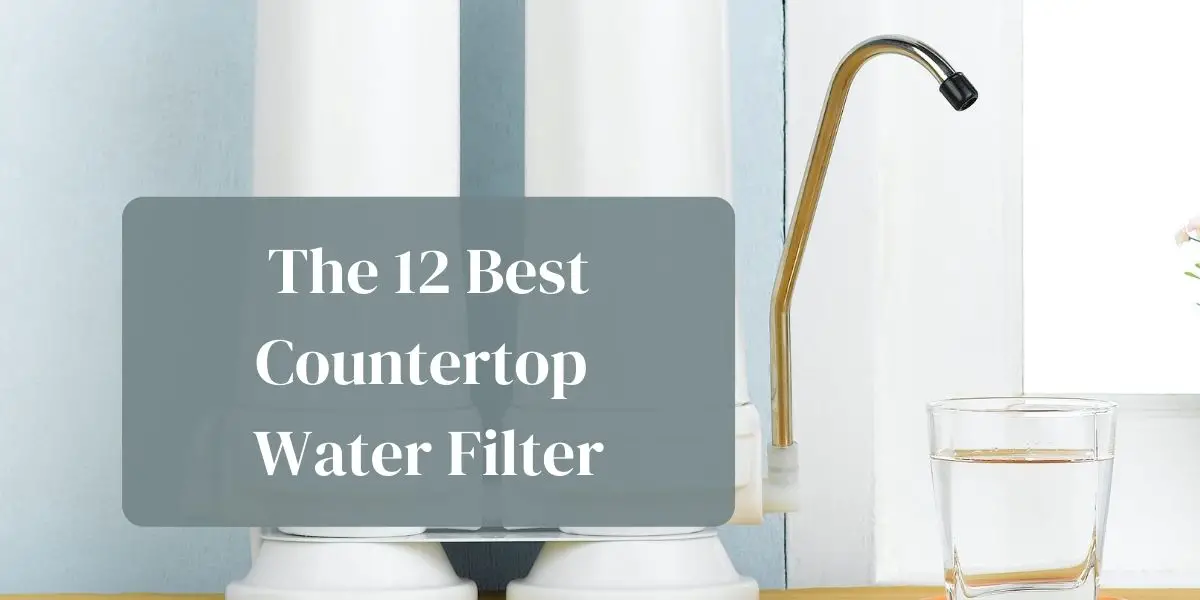
The best countertop water filter is the one certified to reduce the substances found in your water while delivering enough treated water at an acceptable speed and maintenance cost. No countertop system removes everything, and a high stage count is not evidence of performance.
Check the water report or test result first. Then compare the exact model’s certified contaminant claims, capacity, flow, cartridge price and installation needs.
Countertop filter types
| Type | Good for | Main limitation |
|---|---|---|
| Gravity dispenser | No plumbing and simple setup | Slow flow and limited capacity |
| Faucet-connected unit | On-demand filtered water | Needs a compatible tap and bench space |
| Countertop reverse osmosis | Broader dissolved-contaminant reduction | Wastewater, power or tank requirements |
| Countertop distiller | Produces distilled water | Slow, energy-intensive and requires cleaning |
| Powered ultrafiltration system | Fine particle and some microbial reduction | Claims depend on pore size and certification |
Start with the water problem
A chlorine taste problem may need certified activated carbon. Lead, PFAS, nitrate, fluoride, arsenic, microbes, hardness and salinity require different treatment. A filter designed for taste and odour should not be assumed to reduce a health-related contaminant.
The CDC’s home-filter guide explains how treatment types differ and recommends checking the label for the substance the product is designed to reduce.
Read the certification claim precisely
NSF/ANSI 42 generally covers aesthetic effects such as chlorine taste and odour. NSF/ANSI 53 covers specified contaminants with health effects, while NSF/ANSI 58 covers reverse-osmosis systems. Certification must name the exact model and reduction claim.
NSF’s water-treatment standards guide explains the main standards. Use the certifier’s public listing to confirm a product rather than relying only on a logo in advertising.
Capacity and flow
- Estimate daily drinking and cooking water rather than total household water.
- Check rated flow under realistic pressure and temperature conditions.
- For gravity systems, compare reservoir size with the space available.
- For RO, check treated-water production and wastewater ratio.
- Treat cartridge capacity as conditional on water quality and usage.
- Make sure the unit fits below cupboards and leaves room for filling and cleaning.
Five-year ownership cost
A cheap housing can become expensive if it uses proprietary cartridges. Calculate the unit, replacement filters, membranes, electricity, wastewater, cleaning supplies and likely service over five years. Confirm that cartridges are locally available and not nearing discontinuation.
Maintenance and hygiene
A filter can become a hygiene problem when cartridges are used beyond their rated life or the reservoir is not cleaned. Follow the maker’s replacement, sanitation and flushing instructions. Replace the cartridge early if required by reduced flow, water quality or a boil-water notice.
Do not use a standard household filter to make microbiologically unsafe water safe unless the exact system is certified for the relevant organism and conditions. Boil-water advisories and private-water emergencies require public-health guidance.
PFAS and other specific claims
For PFAS, the US EPA advises choosing products certified under NSF/ANSI 53 or 58 for the relevant reduction claim and checking the certifier’s listing. Its PFAS filter guide explains how to verify the label.
Questions before buying
- Which test result shows that treatment is needed?
- Which named contaminants is this exact model certified to reduce?
- What are the rated flow, capacity and operating conditions?
- How much do all replacements cost over five years?
- Does it need electricity, a drain, a special faucet or permanent plumbing?
- Who provides warranty support and replacement parts locally?
For systems that treat every tap, see Whole-House Water Filters: How to Choose. Our countertop reverse-osmosis guide covers the higher-reduction option in more detail.
Bottom line
Ignore stage counts and generic purity claims. Test or identify the water problem, verify the exact certification, compare flow and five-year cost, and choose a countertop format that the household can clean and maintain correctly.


I have a house with the old pipeline and I am actually looking for countertop water filter what is the best product for such a house.