
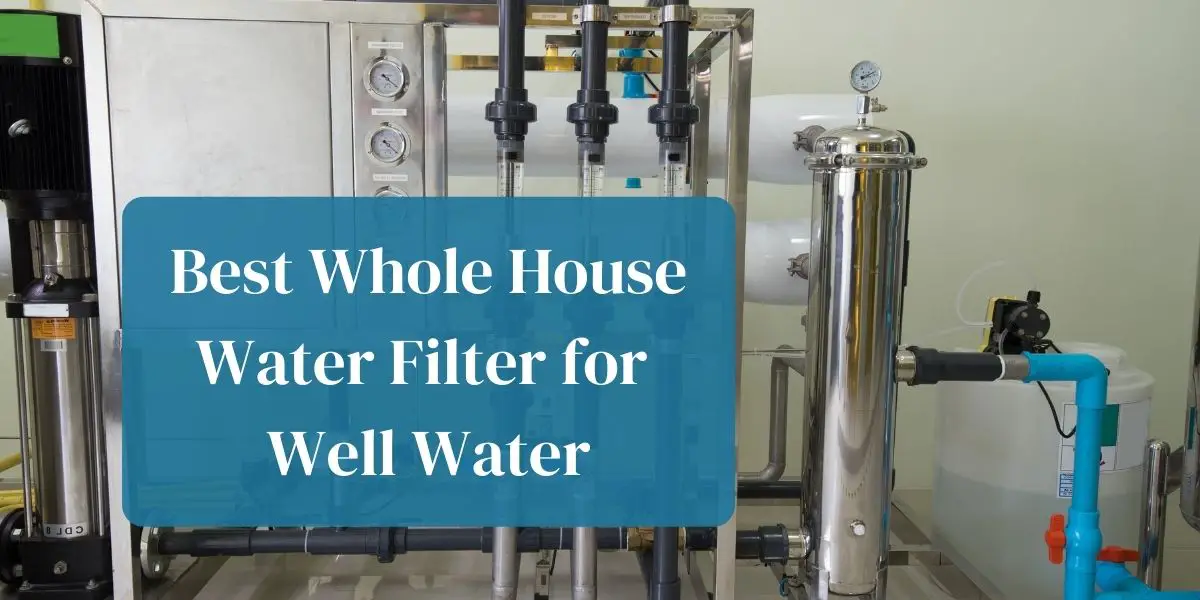
The best whole-house filter for well water is not a particular brand. It is a treatment train selected from a certified laboratory test, sized for the home’s peak flow and supported by a maintenance plan. Sediment, iron, hardness, nitrate, arsenic, PFAS and microorganisms behave differently. No single cartridge removes them all.
Private wells are not regulated like public water systems in the United States, so the owner is responsible for testing and treatment. This guide shows how to move from a lab report to an appropriate point-of-entry system without buying a generic “well-water filter” that may solve the wrong problem.
Start with the well, not the equipment
Treatment should not substitute for a sanitary well. Inspect the cap, casing, grading and nearby contamination risks, and address flooding or structural defects. The EPA recommends annual private-well testing for total coliform bacteria, nitrate, total dissolved solids and pH, with additional tests based on local risks and changes in taste, colour or smell.
Use a state-certified or otherwise appropriately accredited laboratory and follow its sampling instructions. If a result exceeds a health limit, contact the local health department or a qualified water professional. Do not rely on a sales representative’s demonstration alone.
Point of entry versus point of use
A point-of-entry system treats water as it enters the house. It can be appropriate when a contaminant affects plumbing, bathing, laundry or many taps—for example sediment, iron, manganese, acidity or hardness. A point-of-use system treats one tap and may be more practical for a drinking-water contaminant when whole-house treatment adds cost or introduces other risks.
The CDC’s home-treatment overview stresses that different systems remove different germs and chemicals. The treatment label must identify the exact contaminant or performance claim; “purifies well water” is not enough.
Match the contaminant to the process
| Finding | Common treatment approach | Important limitation |
|---|---|---|
| Sand, silt or visible particles | Spin-down separator or sediment filtration | Does not make microbiologically unsafe water safe |
| Iron or manganese | Oxidation followed by filtration; sometimes specialised media | Chemistry, pH and dissolved/particulate form determine design |
| Hardness | Cation-exchange softener | Adds sodium or potassium and does not remove most other contaminants |
| Sulfur odour | Source investigation; oxidation, aeration or catalytic media as appropriate | Odour may have multiple causes; disinfection and ventilation can be safety issues |
| Bacteria or other microbes | Well correction and disinfection; validated UV or another barrier where appropriate | UV needs clear water, correct dose, power and lamp maintenance |
| Nitrate, arsenic or similar drinking-water contaminants | Contaminant-specific adsorptive media, ion exchange or reverse osmosis | Whole-house treatment may not be necessary; waste handling and breakthrough monitoring matter |
| PFAS or organic chemicals | Certified activated carbon, anion exchange or high-pressure membrane for the stated compounds | Performance varies by compound, water chemistry, flow and replacement schedule |
| Low pH or corrosivity | Neutralising media or chemical feed after professional design | Can alter hardness and requires monitoring |
The CDC’s well-water treatment guidance makes the central point plainly: no single treatment protects against every problem. More than one stage may be necessary, and the order of those stages matters.
A sensible treatment order
- Protect the well and correct structural faults. Keep surface water, pests and contaminants out before adding equipment.
- Remove coarse sediment where testing and inspection justify it. This protects downstream valves and media without creating unnecessary pressure loss.
- Address iron, manganese or sulfur. Oxidation and filtration may need contact time, backwashing and drainage.
- Correct hardness or pH if required. These processes can change the chemistry seen by later stages.
- Apply contaminant-specific treatment. Carbon, ion exchange, membranes or other media must be selected for the measured concentration and flow.
- Add a microbial barrier when the risk assessment calls for it. A UV unit normally belongs after filtration so turbidity does not shield organisms.
- Use point-of-use polishing only where it has a defined purpose. A kitchen-tap system can target drinking water without treating toilets, showers and outdoor taps.
This is a design sequence, not a universal prescription. For example, some oxidants can damage ion-exchange resin, while some media need a particular pH. A professional should confirm compatibility and local plumbing-code requirements.
How to size a whole-house system
Peak service flow
Count fixtures that can run together and estimate the realistic peak flow, not just daily consumption. A filter rated for ten gallons per minute under ideal conditions may create unacceptable pressure loss as media loads with sediment. Ask for a pressure-drop curve at your expected flow and for the minimum backwash flow if the tank regenerates.
Contaminant load
Concentration multiplied by water use determines how quickly media is exhausted. Two homes with the same arsenic or iron result can need different vessel sizes because their occupancy and water demand differ. Capacity claims should specify the test conditions.
Contact time and bed depth
Activated carbon, oxidation media and adsorptive media need enough contact time. A small tank with a large pipe connection is not automatically a high-capacity system. Confirm the media quantity, empty-bed contact time or certified flow for the relevant claim.
Drainage, power and space
Backwashing filters and softeners need a code-compliant drain and adequate flow. UV needs reliable power and space for lamp replacement. Chemical-feed systems need safe storage, secondary containment and professional calibration. Include these requirements before choosing the installation location.
Certification and evidence
Look for certification that matches the product type and claim. NSF explains its drinking-water treatment standards, including standards for aesthetic effects, health effects, reverse osmosis, UV and other systems. Certification to one standard or for one contaminant does not prove performance for every claim on a seller’s page.
- Verify the exact model number in the certifier’s directory.
- Check the certified contaminant, influent concentration, flow and capacity.
- Distinguish certified materials or components from certification of the complete system.
- Ask for a sampling plan that confirms treatment continues to work before media exhaustion.
- Avoid unsupported universal percentages such as “removes 99% of all contaminants.”
Maintenance is part of the treatment
A neglected whole-house system can lose capacity, harbour growth, channel through media or reduce pressure. Keep a log of pressure, flow, test results, service dates and replacement parts. Replace cartridges on measured pressure loss and the manufacturer’s limit, not appearance alone. Backwashing media need periodic inspection, and UV systems need lamp and sleeve maintenance.
Retest after installation, after major service and whenever water quality changes. For health-related contaminants, test early enough that media can be replaced before breakthrough. Keep untreated and treated sampling points where practical.
How whole-house filters relate to carbon filters and softeners
Activated carbon can reduce certain tastes, odours and organic chemicals, but it does not soften water and is not a universal microbial barrier. Our whole-house carbon filter guide explains carbon type, contact time and certification.
A softener targets calcium and magnesium. It may also handle limited dissolved iron when the manufacturer allows it, but high iron or sediment can foul the resin. See water-softener troubleshooting and conditioners versus softeners before combining equipment.
Questions to ask before buying
- Which certified-lab results is each stage designed to address?
- What remains untreated?
- What is the rated service flow and pressure drop?
- What water chemistry limits apply?
- How often will cartridges, media, lamps or chemicals need replacement?
- Where will backwash or reject water go?
- How will performance be verified after installation and over time?
- Who can service the exact valve, controls and media locally?
- What is the ten-year cost, including testing, water, salt, power and replacement parts?
A good proposal should connect every component to a test result or an operational need. If it cannot, simplify it. Test the well, correct the source, select certified treatment for the measured problem, size it for real flow and plan verification from day one.

I replaced my water filter with #1 and was amazed at the difference they made. My water tastes better and is more aromatic, with no residue left. Also very easy to install.