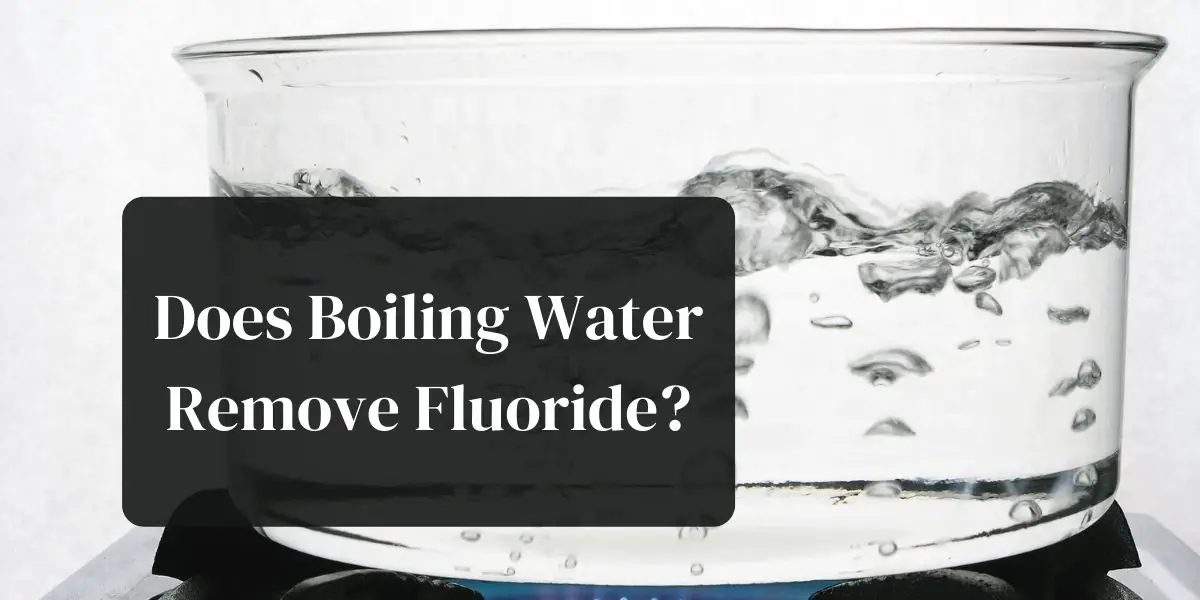
No. Boiling water does not remove fluoride. Because water evaporates while dissolved fluoride generally remains behind, prolonged boiling can slightly increase the fluoride concentration in the water that remains.
Boiling is valuable for killing many disease-causing organisms during a boil-water advisory. It is not a general method for removing dissolved minerals, salts or metals.
Why boiling does not remove fluoride
Fluoride in drinking water is present mainly as dissolved ions. At ordinary boiling temperatures, the water changes to vapour but the dissolved fluoride does not simply disappear with it. If some water is lost as steam, roughly the same fluoride mass can remain in a smaller volume.
| Method | What happens | Fluoride result |
|---|---|---|
| Boiling in an open pot | Some water escapes as vapour | Fluoride remains and may become more concentrated |
| Distillation | Vapour is captured and condensed elsewhere | Most dissolved fluoride stays in the boiling chamber |
| Reverse osmosis | Pressure moves water through a selective membrane | A certified system can reduce fluoride |
| Ordinary carbon filter | Carbon adsorbs selected compounds | Do not assume fluoride reduction |
Boiling and distillation are different
A distiller boils water but then collects the vapour and condenses it into a separate container. Most dissolved minerals remain in the original chamber. An open kettle or saucepan does not collect and separate that vapour, so it is not distillation.
Distillation is slow, uses electricity and requires regular removal of scale. Volatile contaminants may also need additional control, depending on the appliance and source water.
What can reduce fluoride?
Reverse osmosis is the most accessible household option with a recognised certification pathway. The US Centers for Disease Control and Prevention says reverse-osmosis filters may reduce fluoride and advises checking the label for the exact chemicals a system removes.
- Reverse osmosis with model-specific fluoride certification
- Distillation with appropriate operation and maintenance
- Activated alumina or other specialised media under suitable water conditions
- Professionally designed treatment for unusually high natural fluoride
Test or check the report first
Public-water customers should read the supplier’s current water-quality report. Private-source users should arrange accredited laboratory testing. Do not buy treatment based only on an online claim or the assumption that all tap water contains the same concentration.
If a result exceeds a health-based limit, follow the local water or public-health authority’s advice. Treatment selection may depend on pH and other contaminants, and treated water should be retested.
Fluoride also has a dental role
Fluoride helps prevent tooth decay. The US National Institutes of Health fluoride fact sheet explains its role in inhibiting or reversing dental caries and discusses intake and health considerations.
Households removing fluoride from a fluoridated supply should understand the dental trade-off, especially for children. A dentist or appropriate health professional can advise whether another fluoride source is needed.
What to do during a boil-water advisory
A boil-water advisory is normally issued because microbial safety is uncertain. Follow the issuing authority’s exact instructions for boiling time, cooling and storage. Do not substitute a normal household filter unless the authority explicitly says it is suitable.
Boiling water for microbial safety does not mean it has been purified of fluoride, nitrate, salt, lead or every other chemical. If a chemical contamination notice is issued, boiling may be ineffective or counterproductive, so use the alternative water source specified by the authority.
For treatment options, read Fluoride Water Filters: What Actually Works? and our explanation of reverse osmosis and fluoride.
Bottom line
Boiling does not remove fluoride and can concentrate it as water evaporates. Use boiling for the microbial purpose stated in a health advisory. For fluoride reduction, verify the water concentration and choose a treatment with an exact, independently certified fluoride claim.