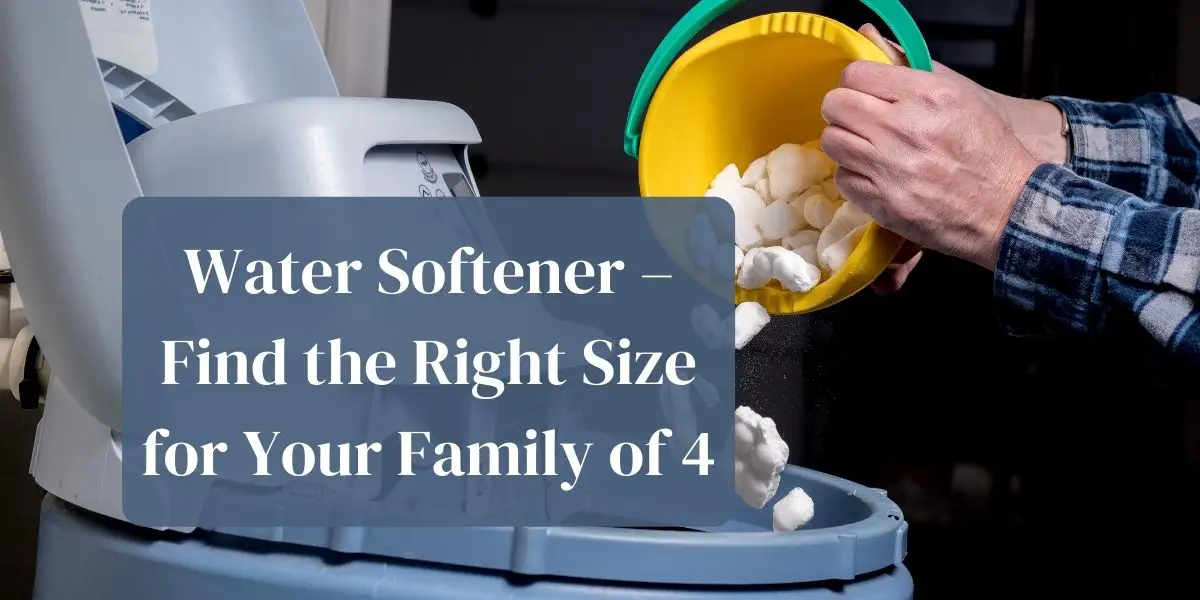
A family of four cannot choose a water softener from household size alone. The correct size depends on measured hardness, daily water use, peak flow, iron or manganese, desired regeneration interval and the unit’s certified capacity at the programmed salt dose.
As a rough illustration, four people using 60 US gallons each per day with 10 grains-per-gallon hardness create about 2,400 grains of hardness load per day. That is an input to sizing—not a recommendation to buy a unit advertised as 24,000 or 32,000 grains.
The basic calculation
Daily hardness load = people × gallons per person per day × hardness in grains per gallon.
| Example input | Value |
|---|---|
| People | 4 |
| Water use | 60 US gallons per person per day |
| Measured hardness | 10 grains per gallon |
| Calculated daily load | 4 × 60 × 10 = 2,400 grains per day |
| Seven days of load | 16,800 grains before reserve and other adjustments |
If your report uses milligrams per litre as calcium carbonate, divide by about 17.1 to convert to grains per US gallon. Use the actual household meter or recent bills when possible; generic consumption assumptions can oversize the system.
Why the advertised grain number can mislead
A model’s largest headline capacity may require an inefficient salt setting. Compare the certified capacity and efficiency at the salt dose you will actually program. NSF explains that NSF/ANSI 44 covers residential cation-exchange softeners and includes material, structural, performance and efficiency requirements.
Check an accredited listing for hardness-reduction capacity, service flow and efficiency. Do not assume two units with the same resin volume or marketing label perform identically.
Peak flow matters
Capacity answers how long the bed can treat water before regeneration. Service flow answers whether it can supply simultaneous showers, taps and appliances without excessive pressure loss or hardness breakthrough. Ask the supplier to size both.
Iron and manganese change the job
Dissolved iron can consume softening capacity and foul resin. Do not apply a universal iron correction from an online calculator. Test the water and follow the selected manufacturer’s documented sizing limits; high iron, oxidised iron, manganese or sediment may need separate treatment.
Minnesota Department of Health notes that softeners remove calcium and magnesium and may be considered above about 7 grains per gallon (120 mg/L), while emphasising that softening is a choice rather than a drinking-water requirement.
A reliable sizing process
- Test hardness and relevant well-water constituents through a qualified laboratory.
- Estimate actual daily use from the meter or bills.
- Calculate daily hardness load.
- Choose a reasonable regeneration interval and add a documented reserve.
- Check certified capacity at the intended salt setting—not maximum theoretical capacity.
- Verify continuous and peak service flow against household demand.
- Confirm drain, bypass, electrical and installation requirements.
Avoid oversizing
Bigger is not automatically better. A heavily oversized unit can go too long between regenerations, cost more and use space without improving water. A small unit may regenerate too often and waste salt and water. Demand-initiated controls help, but they still need correct settings.
After choosing the size, follow our guides to safe water-softener installation, maintenance and electronic descalers.
Bottom line
For a family of four, calculate from measured hardness and real water use, then verify certified capacity and service flow. Treat any one-number recommendation as a starting estimate, not a purchase specification.