
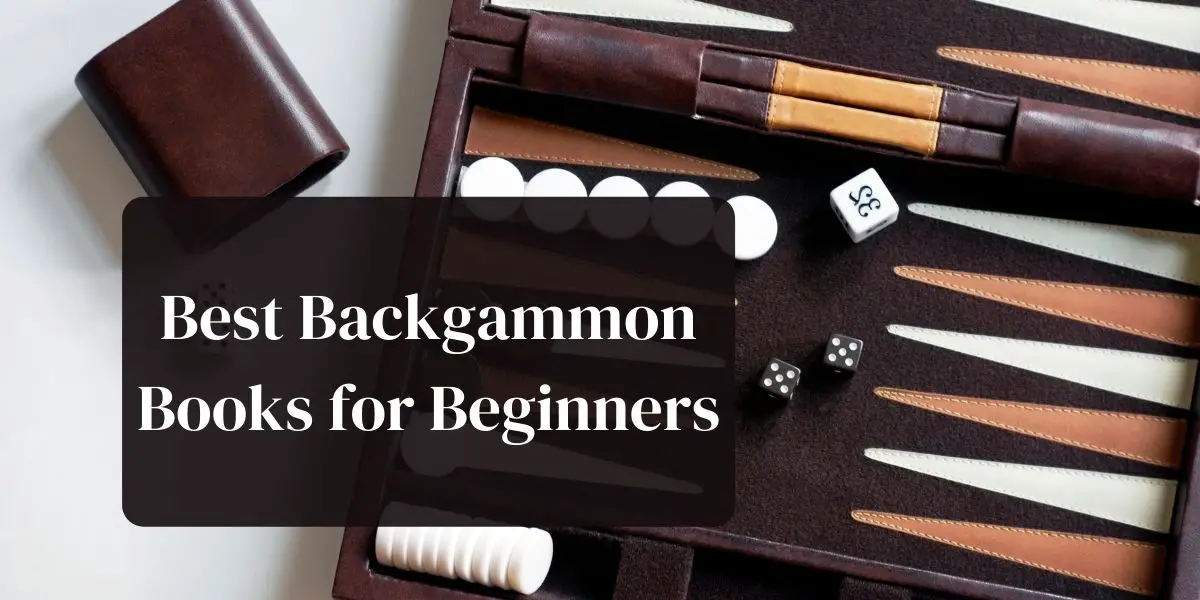
The best backgammon book for a beginner depends on what you already know. A true newcomer needs clear rules and basic checker play. A player who can finish games but keeps making costly decisions needs worked positions, probability and an introduction to the doubling cube.
This guide recommends a short reading path rather than a long shopping list. Start with one book that matches your level, play while you read, and add the next only when you can explain the previous lessons over a real board.
The short list
- Backgammon for Dummies by Chris Bray — the most approachable all-round starting point.
- Backgammon for Winners by Bill Robertie — a concise bridge from rules to sound practical play.
- Backgammon by Paul Magriel — a systematic classic for players ready to study position types.
- 501 Essential Backgammon Problems by Bill Robertie — problem-based practice after the basics are secure.
1. Backgammon for Dummies: best first overview
Chris Bray’s book is suited to readers who need the whole game explained in one place: setup, legal moves, hitting, entering from the bar, bearing off, basic tactics, match play and the doubling cube. Its main strength is accessibility. You can read a section, set up a board and test the idea immediately.
Choose it if you know little beyond the direction the checkers move. If you already play confidently and understand the cube, much of the opening material may feel elementary.
2. Backgammon for Winners: best concise next step
Bill Robertie’s shorter guide is useful when you understand the rules but lack a framework for decisions. It introduces recurring ideas such as making points, escaping back checkers, timing, races and risk. The compact format makes it easier to finish than a reference-sized textbook.
This is a sensible single purchase for a casual player who wants to stop relying entirely on intuition. Work through it slowly and compare its examples with positions from your own games.
3. Backgammon by Paul Magriel: best foundational classic
Magriel organises backgammon around position types and strategic concepts. It is more demanding than a quick beginner manual, but it helps players build a vocabulary for priming, blitzing, holding games, back games and racing. That structure is why the book remains influential even though computer analysis has refined some individual plays since publication.
Use it after you can play a complete game without checking the rules. Treat it as a course, not a book to skim in a weekend.
4. 501 Essential Backgammon Problems: best for active practice
Problem books force you to choose before seeing the explanation. That makes them valuable for diagnosing whether you can recognise a concept under pressure. Robertie’s collection ranges beyond absolute-beginner material, so it works best as a second or third book.
Cover the solution, record your choice and reason, then compare. The reason matters more than a lucky correct answer. Revisit missed positions after a week instead of reading all 501 in sequence.
Learn the rules free before buying a book
If you are unsure whether you will keep playing, begin with the U.S. Backgammon Federation’s beginner guide. It covers movement, hitting, entering and bearing off. Its free beginner video series also introduces match rules and the Crawford rule.
You will learn faster with a board in front of you. If you are still choosing one, our guide to a durable wooden backgammon set focuses on playability, construction and repair rather than a product catalogue.
A four-week study plan
- Week 1: learn legal moves, hitting, entering and bearing off; play five games without the cube.
- Week 2: study opening priorities and races; record one difficult checker decision per game.
- Week 3: add the doubling cube and short matches; review every double and take/pass decision.
- Week 4: solve ten positions, replay your errors and write one sentence explaining each correction.
Which book should you choose?
Choose Backgammon for Dummies for a friendly complete introduction, Backgammon for Winners for a shorter practical course, Magriel for a deeper foundation, and 501 Essential Backgammon Problems when you are ready to test decisions. One well-used book is more valuable than four unread recommendations.


Do you think that “Backgammon for dummies” is good for my friend that just started to play?
He seems to be super serious about the game (lol), but i’m not sure how much he actually knows
Hi! 🙂
yes, I do believe that’s a good book for a beginner.
I’m gonna pick up one of these and actually browse through it.
Not sure about you, but I hate to loose so bad. Especially in board games. It makes me so bitter and angry that it literally ruins my day.
In order to keep playing board games, I got two options:
1) Get better at backgammon by reading some books.
2) Stop playing backgammon and try some other board games lol
What I found most interesting reading this article (browsing a gift for my brother)….is that I thought backgammon was a game of luck,? Lol
I had no idea that any skills or strategy were involved. But of course: that makes the game an actual board game.
If it was all about luck, I guess people would not arrange tournaments in backgammon. I watched about 15 minutes of the Youtube video you added in the article…but figured out that this game probably isn’t for me lol 😛
501 essential backgammon problems is the perfect gift for my dad.
I was not only reading your review of it. But I saw a lot of people on Amazon were quite stoked about the book as well.
To be honest, it appears that this book is suitable for someone who have played backgammon for 3-4 months and understand the basics of the game.
Hi! That’s great to hear 🙂
I’m sure your dad will be happy with that gift if he wants to improve his backgammon skills. It’s a brilliant book.